Saturday, September 24, 2011

Module 3: The Invention of Hugo Cabret by Brain Selznick

"I like to imagine that the world is one big machine.  You know, machines never have any extra parts.  They have the exact number and types of parts they need.  So I figure if the entire world is a big machine, I have to be here for some reason, too."


www.goodreads.com
Citations
Selznick, B.  (2007).  The invention of Hugo Cabret.  London:  Scholastic Ltd.

Summary
Part novel, part picture book, part graphic novel, part film on paper, this book tells the story of Hugo Cabret, a twelve-year-old boy who lives inside the walls of a Paris train station in the year 1931.  Believing a wind-up toy (also called an automaton) holds a connection to a father, Hugo longs to bring it back to life.  As he balances winding the train station's clocks and fixing the toy, he meets an angry old toymaker, an intriguing young girl, and a mysterious older boy with an eyepatch, and his secret mystery is suddenly in danger.  The story explores a little-known world of amazingly lifelike mechanical figurines, silent films, and the magic and dreams contained therein.  Winner of the 2008 Caldecott Medal.

My Impressions
I was initially interested by the format of the book, mixing full-page pencil drawings with novel-like narration.  I was immediately drawn into the story by the opening sequence of images and subsequent text.  Hugo is a loveable child with a mesmerizing story.  This book reminded me what I loved about books when I was a kid:  characters that you felt like you knew, or wanted to be friends with; faraway places and the exposure to new and  fascinating things, like automata and silent films.  There's magic in between the covers of this book, and I hope that kids give this 500-page book a chance after seeing how thick it is.

Review
"Gr 4-9 -- With characteristic intelligence, exquisite images, and a breathtaking design, Selznick shatters conventions related to the art of bookmaking in this magical mystery set in 1930s Paris.  He employs wordless sequential pictures and distinct pages of text to let the cinematic story unfold, and the artwork, rendered in pencil and bordered in black, contains elements of a flipbook, a graphic novel, and film.  It opens with a small square depicting a full moon centered on a black spread.  As readers flip the pages, the image grows and the moon recedes.  A boy on the run slips through the grate to take refuge inside the walls of a train station-home for this orphaned, apprentice clock keeper.  As Hugo seeks to accomplish his mission, his life intersects with a cantankerous toyshop owner and a feisty girl who won't be ignored.  Each character possesses secrets and something of great value to the other.  With deft foreshadowing,  sensitively wrought characters, and heart-pounding suspense, the author engineers the elements of his complex plot:  speeding trains, clocks, footsteps, dreams, and movies-especially those by Georges Melies, the French pioneer of science-fiction cinema.  Movie stills are cleverly interspersed.  Selznick's art ranges from evocative, shadowy spreads of Parisian streets to penetrating character closeups.  Leaving much to ponder about loss, time, family, and the creative impulse, the book closes with a waning moon, a diminishing square, and informative credits.  This is a masterful narrative that readers can literally manipulate."

Lukehart, W.  (2007).  [Review of The invention of Hugo Cabret by B. Selznick].  School Library Journal.  53(3), 218.  Retrieved from http://www.schoollibraryjournal.com.


Suggested Library Uses
The back of the book features websites for more information about automata and Georges Melies, the filmmaker in the novel, as well as credits for images and citations for the real films mentioned in the book.  

  • Host an informative session about the history of automata.  Have some machines available for demonstration, or at least video clips of automata.  Wooden kits are available for purchase, but can be pricey.  The children's toy, K'nex will also serve the purpose.  A trip to a local museum that has automata, if applicable, is also a good idea.
  • Host a silent film night.  Discuss Georges Melies' contribution to silent film.  Reading the book Before Hollywood: From Shadow Play to the Silver Screen by Paul Clee can teach about early films. Show a silent film (not necessarily by Melies, though this or one mentioned in the book would be a bonus!).  If children in the audience become antsy, invite some to come forward and provide the dialogue. 
Find it @ Your Library - Albany County Public Library
J SE489I

Notes
Winner of the Caldecott Medal, 2008
Top Ten, YALSA Best Books for Young Adults, 2008
National Book Award Finalist, 2007
Nominee, Wyoming's Indian Paintbrush Award (Grades 4-6), 2008-2009


Wednesday, September 21, 2011

Module 3: Tuesday by David Wiesner

"...there is always another Tuesday."
www.goodreads.com
Citation
Wiesner, D.  (1991).  Tuesday.  New York:  Clarion Books.  


Summary
On a seemingly ordinary Tuesday evening, toads take off from their swamp, flying through the air on lily pads.  They spend the night exploring the neighborhood, with surprises for both the toads and the few residents who are awake.  When morning comes, the frogs must return to the swamp, leaving their lily pads behind as puzzling evidence of their excursions.  What will happen next Tuesday, around eight o'clock?  Winner of the 1992 Caldecott Medal.


My Impressions
Words are nearly absent in this book, allowing Wiesner's whimsical illustrations to take charge of the storytelling.  Each picture invites the reader to step into the story and enjoy even the smallest of details.  I enjoyed the different perspectives and the use of comic book-like panels on some pages.  The story sparked my imagination and had me dreaming about flying frogs the night I read it.  


Review
School Library Journal
"K-Gr 4--As the full moon rises over a peaceful marsh, so do frogs on their lily pads levitating straight up into the air and sailing off, with surprise with some laundry, hovering briefly before a TV left on. A dog chases one lone low coasting frog, but is summarily routed by a concerted amphibious armada. Suddenly the rays of the rising sun dispel the magic; the frogs fall to ed but gratified expressions. Fish stick their heads out of the water to watch; a turtle gapes goggle-eyed. The phalanx of froggies glides over houses in a sleeping village, interrupting the one witness's midnight snack, tangling the ground and hop back to their marsh, leaving police puzzling over the lily pads on Main Street. In the final pages, the sun sets on the following Tuesday--and the air fills with ascending pigs! Dominated by rich blues and greens, and fully exploiting its varied perspectives, this book treats its readers to the pleasures of airborne adventure. It may not be immortal, but kids will love its lighthearted, meticulously imagined, fun-without-amoral fantasy. Tuesday is bound to take off."


Dooley, P. (1991). [Review of the book Tuesday by D. Wiesner]. School Library Journal, 37(5), 86. Retrieved from http://www.schoollibraryjournal.com.


Suggested Library Uses


  • Read/present the book to children.  Have them take turns narrating each page, each providing a sentence or two.  Have an assistant write down the story as the children tell it.  Re-reading the story with the new narration is a possibility.  
  • Alternatively, read the book to the children, and have them draw, paint or describe what they think will happen "next Tuesday," based on the last image.  In either case, emphasize to parents or teachers the literacy skills taught by having children supply the narration or create their own story. 
Find it @ Your Library - Albany County Library
E W6373TU

Notes
Winner of the Caldecott Medal, 1992


Tuesday, September 6, 2011

Module 2: Blueberries for Sal by Robert McCloskey

"Kuplink, kuplank, kuplunk!"
indiebound.org
Citation
McCloskey, R.  (1976).  Blueberries for Sal.  New York:  Viking Press.

Summary
Little Sal and her mother head to Blueberry Hill to pick blueberries for canning for the winter.  On the other side of the hill, Little Bear and his mother are eating blueberries to prepare for hibernation.  Both little creatures become separated from their mothers while eating blueberries and end up following the wrong one!  Both mothers go home with their children and full bellies and pails for the winter.

My Impressions
The cover for this popular children's book had never really appealed to me, but I wanted to read it this week because many of my friends fondly remember the story.  I was immediatly drawn into this charming tale about a little girl and her mother picking blueberries.  The black and white illustrations are realistic, but not overly detailed.  Both the setting and characters come to life, with landscapes that stretch across both pages and an overall strap that can't seem to stay atop Sal's shoulder.  It is easy to imagine any little preschooler carrying that tin pail. There is little to show the age of the book, as only the mother's clothing and hairstyle indicate the time period in which the book was created.  The language is simple but fun, as Little Bear hustles after his mother while munching berries and Sal drops berries in her pail with a "kuplink!"      

Review
"And School Library Journal’s starred review said, 'All the color and flavor of the sea and pine-covered Maine countryside.'"

Bird, E.  (2009, April 30).  Top 100 Picture Books Poll Results #13 [Web log post].  Retrieved from http://blog.schoollibraryjournal.com/afuse8production/2009/04/30/top-100-picture-books-poll-results-13/.

Suggested Library Uses
  • For a storytime for 4-6 year-olds, discuss animal safety and the importance of not wandering too far away from parents/guardians.  Have children share any experiences in the outdoors.  Play a "Hi-Ho Cherry-O"- style game with blue beads and pails, encouraging the children to drop their "blueberries" and enjoy the "kuplunk" sound.  Ensure the beads are large enough to be safe for younger participants.
  • Host a berry-picking party at a park or nearby outdoor recreation area.  Prepare a simple recipe using the berries, emphasizing steps that children can perform.  Read the book before picking berries or during a lull in the food preparation.
Find it @ Your Library - Albany County Library
E M1326B


Notes
Caldecott Honor Book, 1949
Original illustrations were done in blue ink, adding to the blueberry experience! (see Bird blog posting cited above)

Tuesday, August 30, 2011

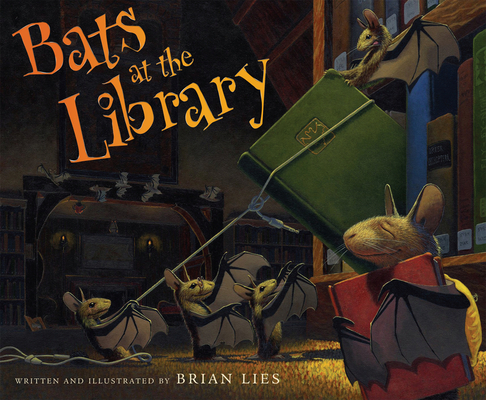
Module 1: Bat Night at the Library

"Can it be true? Oh, can it be?
Yes! -- Bat Night at the library!"

indiebound.org


Citation
Lies, B.  (2008).  Bats at the library.  New York:  Houghton Mifflin Company.

Summary
Excitement builds in the bat colony as the news spreads:  a window has been left open at the public library!  Eager for something to break the boredom, they flock toward the library.  The older ones seek out favorite books and the youngest explore and play in the library.  They are finally settled down and soon discover the magic of books during their first "Bat Night at the Library" storytime.  

My Impressions    
The friendly little bats come to life in Lies' detailed and playful illustrations.  The richer tones both lend the book a cozy, slightly eerie autumnal feeling and entice the reader to image his or her own library after hours.   I also enjoyed the "bat-ified" details on many pages, my favorites being references to popular children's books (for example, Alice confronting a Cheshire Bat). The rhyme of the text gives the story a lyrical flow without overtaking the story.  It is an imaginative and entertaining tale sure to capture the interests of 4- to 8-year-olds.

Review    
Publisher's Weekly
"Starred Review. Lies's (Bats at the Beach) much-lauded bats are back and the library's got them—thanks to a window left open by an unsuspecting (or perhaps sympathetic) librarian. Although the young ones initially misbehave (they make photocopies of their bodies and turn the water fountain into a splash pool), Lies cuts them a little slack: It's hard to settle down and read/ when life flits by at dizzy speed. Story time settles everyone (upside-)down, and soon the furry creatures are completely swallowed up in books, giving Lies comic license to bat-tify the signature visuals from classics like Make Way For Ducklings; Pippi Longstocking; Goodnight, Moon and Peter Rabbit. As with its predecessor, this book's richly detailed chiaroscuro paintings find considerable humor at the intersection where bat and human behavior meet. But the author/artist outdoes himself: the library-after-dark setting works a magic all its own, taking Lies and his audience to a an intensely personal place. Ages 4–8."

[Review of the book Bat Night at the Library by B. Lies]. (2008). Publishers Weekly, 255(28), 65. Retrieved from http://www.publishersweekly.com.

Suggested Library Uses
  •  Read to children to set the stage for a children's library orientation at a public or school library.  Ask the children what they like to do at the library.  Talk about the images depicting popular children's books and see if they can identify any.
  • Read during a children's Halloween festival.  Include other bat-themed books.  Ask children what they would do if they could go to the library after it was closed.  Have bat-themed crafts and activities.

Find it @ Your Library - Albany County Library
E L625B


Notes
Nominee for Wyoming's Buckaroo Book Award (grades K-3) for 2009-2010.