Saturday, November 12, 2011

Module 10: Boxes for Katje by Candace Fleming

"'I have a box for Katje--a box from America!'"
friendsbalt.org
Citation
Fleming, C.  (2003).  Boxes for Katje.  New York:  Melanie Kroupa Books.

Summary
In a small Dutch town shortly after World War II, little Katje is surprised one day to receive a package from the United States.  It turns out to be a care package sponsored by the Children's Aid Society.  Inside she finds soap, socks, and chocolate, all of which are in short supply following the war.  She shares her gift with her mother and postman and writes a letter of thanks to Rosie, the American girl who sent the box.  Rosie and her mother are touched by Katje's letter and send sugar to Katje, which she shares with even more friends.  The cycle continues throughout the winter, each time the gifts from Rosie becoming more plentiful as her friends in America contribute to the boxes.  By the end of the winter, Katje's entire village has benefited from Rosie's generosity and Katje decides to repay her with a thoughtful Dutch gift:  tulips, straight from her mother's garden.   The story is based on the author's mother's childhood experience of sending a relief box to Holland and continuing the correspondence throughout the winter. 

My Impressions
Boxes for Katje tells a cheerful story about the joy that can be spread by a little generosity.  The text is simple, colorful, setting the scene for the story.  The dialogue is somewhat stilted, included mostly to provide context and advance the story, but does not distract from the main points.  Each new box repeats the cycle of opening the box, sharing the contents, and writing a letter that unintentionally reveals a new need.  This pattern is not obvious and helps children to follow along and know what to expect.  The illustrations, done in pencil, oil pastel, and acrylic, are bright and emotive, helping the reader to place himself into the story.  I especially enjoyed the inclusion of each letter, written in either Rosie's or Katje's handwriting.  Children will delight to see how the overseas correspondence grows, and might perhaps be inspired to share a little themselves. 

Reviews
School Library Journal
"Gr 1-4- "After the war, there was little left in the tiny Dutch town of Olst. The townspeople lived on cabbages and seed potatoes. They patched and repatched their worn-thin clothing, and they went without soap or milk, sugar or new shoes." Set in post-World War II Holland and based on an actual incident, this story illuminates a little-known episode in history. To offset the devastation left by the war, the Children's Aid Society and other relief agencies encouraged American students to send boxes of basic necessities to victimized children. When Katje in Olst receives such a box from Rosie in Mayfield, IN, the two begin a correspondence that eventually triggers a relief effort that enables this small Dutch town to make it through an unbearably frigid winter. Fleming does an estimable job of bringing time and place into focus, and presents endearing, fleshed-out characters with whom readers can easily empathize and sympathize. Dressen-McQueen's warm-toned colored-pencil, oil-pastel, and acrylic illustrations accurately reflect dress, architecture, and other details, and the facial expressions and body postures of the characters effectively convey their joy in these much-appreciated gifts. A good choice for storyhour as well as for independent reading and an excellent discussion starter."

Oliff, G., Jones, T. E., Charnizon, M., Grabarek, D., Larkins, J., & L. Toth.  (2003). [Review of the book Boxes for Katje by C. Fleming].  School Library Journal, 49(9), 177-178.

Horn Book Magazine
"Amidst the deprivations of life in post-WWII Holland, young Katje receives a care package from an American girl. Katje writes a thank-you note to Rosie, who, when she hears about Katje's generosity with the handful of gifts, begins recruiting friends and neighbors to help send bigger and bigger packages to Katje, who shares the bounty with her friends and neighbors. Fleming has carefully shaped her story so that Katje's heartfelt letters unintentionally inspire further gifts from Rosie (a clothing drive at Rosie's church results from Katje's innocent mention of how the box of food made everyone so happy they forgot about the holes in their shoes). The opening endpapers show Rosie's Indiana neighborhood in 1945; closing endpapers feature the same scene two years later, each yard overflowing with color--from the tulip bulbs Katje's community sends to express their gratitude. First-time illustrator Dressen-McQueen keeps the sentimentality of the story at bay with artwork that matter-of-factly presents Katje's poverty and Rosie's relative prosperity while, like the text, emphasizing their similarities: the secure warmth each experiences at home and their desire to help others. Reflecting the story's theme about friendship's ability to bridge long distances, the multimedia illustrations often overlay a scene from Katje's hometown with one of the girls' handwritten letters and a snapshot-like picture of Rosie's home. An author's note provides further information on the actual events that inspired Fleming's story."

Brabander, J. M. (2003). [Review of the book Boxes for Katje by C. Fleming]. Horn Book Magazine, 79(5), 596-597.

Suggested Library Uses
  • A great choice for a storytime about sharing or gift-giving. 
  • Use the story as inspiration to participate in a similar community effort, such as Operation Christmas Child or a Red Cross response to a natural disaster.

Find it @ your library - Albany County Public Library
E F629BO

Module 9: The Kneebone Boy by Ellen Potter


"Sometimes you have to start a thing for all the wrong reasons in order to discover the right ones."
blog.schoollibraryjournal.com
Citation
Potter, E.  (2010).  The kneebone boy.  New York:  Feiwel and Friends.


Summary
Otto, Lucia (that's Lu-chee-ah), and Max Hardscrabble are a little bit strange.  Their father, Casper, is an artist who travels around the world painting portraits of fallen royalty.  Their mother has gone missing, and many suspect she has died.  They spend their days in Little Tunks, England mostly with each other, wishing something interesting would happen.  When they are sent to stay with an aunt who is not home, they decide to go in search of a long-lost aunt-in-law, Haddie Piggit.  It is then their adventure begins. Great Aunt Haddie lives in a curious seaside village in a miniature version of a mysterious old castle, called a castle folly.  There they learn about the legendary creature, the Kneebone Boy, rumored to be half boy and half animal, and decide to find him.  Their quest for this oddity takes them throughout the unique folly, around the grounds, and into the castle itself, where they learn important lessons about themselves and their family.  


My Impressions
The narrator of this book, though a mystery to the reader, is deliciously candid, smart, and charming.  One cannot help but chuckle at the narrator's observations of him- or herself, the Hardscrabble children, and the world around them.  While the Hardscrabble children initially feel very much like the Baudelaire orphans of A Series of Unfortunate Events (Snicket, 1999), their identities and adventures soon become their own.  While it takes a little while for the mystery to evolve, readers are encouraged at each turn of the page as they learn more about the kids and their odd, American Great Aunt Haddie.  It's a little spooky, a little funny, a little bit sleepy, but very much heartwarming and worth the read.  


Review
Kirkus Reviews
"The Hardscrabbles of the English town of Little Tunks--silent Otto, the adventure-seeking Lucia and whip-smart Max--have become accustomed to their shy, rumpled father's absences since their mother's suspicious disappearance. ("'She's dead,' Lucia said. 'She's gone missing,' said Max.") On one such occasion, Mr. Hardscrabble's miscommunication with a London relative leaves the trio perilously alone in the big city. Barely escaping the clutches of an angry tattooed man, they manage to track down their great aunt Haddie Piggit, a youngish, eccentric American with a penchant for Pixy Stix who lives in a child-sized version of the adjacent Kneebone Castle in Snoring-by-the-Sea. Could she be their mother? Does Otto, the oldest at 13, know and not say? Does the legendary, tower-bound Kneebone Boy really have hat ears? Narrated quite personably by one of the Hardscrabbles who refuses to be identified but is obvious, the story is fresh, funny and surprising. The sibling dynamics--alternately testy and touching--are believable, as are the wonderfully odd characters from the hulking taxidermist Saint George to the ethereal Sultan of Juwi. A quirky charmer. (Fiction. 11 & up)"

[Review of the book The kneebone boy by E. Potter].  (2010).  Kirkus Reviews, 78(17) 864.

Suggested Library Uses
  • This book should be on any Series of Unfortunate Events read-alike list and would make a great addition to a display of comedic mysteries.  


Find it @ your Library - Albany County Public Library
J Potter, Ellen

Module 8: The City of Ember by Jeanne DuPrau

"There's so much darkness in the City of Ember, Lina.  It's not just outside, it's inside us, too."

lookingglassreview.com
Citation
DuPrau, J.  (2003).  The city of Ember.  New York:  Random House Children's Books.


Summary
The city of Ember is lit purely by electricity, but this is all its citizens know.  Beyond the city limits it is pitch-black, and no one has dared venture out.  But the city is failing.  Power outages are becoming frequent and the food stores are running low. Children attend school until the age of twelve, at which point they receive their randomly-chosen work assignments.  Lina wanted to be a Messenger, delivering messages around the city.  Doon wanted to work in the Pipeworks, to understand how the city is powered and figure out what is causing the power outages.  It is only after the two old friends trade jobs that both are satisfied--and both begin to question the future of Ember.  Their curiosity increases when Lina uncovers a mysterious and incomplete message about their city.  As they work to decipher the meaning, Lina and Doon discover unsettling truths about Ember.  What will happen when the power does not come back on?  What will the city do when the food runs out?  What lies beyond the flickering lights of Ember?  


My Impressions
Lina and Doon are smart, hardworking, and relatable young people.  Readers immediately take a liking to both as they wait anxiously for their work assignments at the start of the book.  Feeling almost more like a mystery than science fiction, the book pulls the reader into the streets of Ember, giving out only as much information as necessary about what the city is and how it operates.  The cryptic message Lina discovers leads her and Doon through an exciting adventure around and out of Ember.  Though it takes a little while to pick up speed, the novel reads quickly, effectively combining insight, suspense, and action.  Readers who finish this book will want to jump right to the next book in the series.


Reviews

Horn Book Magazine
"Unlike the rundown dystopia of Lois Lowry's Gathering Blue, the darkness of Ember is essentially literal. Its people, by and large, are honorable and civilized; its governance is democratic if quasi-theocratic; its economy frugal but fair. But there is no natural light in Ember, and the blackouts of its antiquated electrical grid are coming more and more frequently: "running out of light bulbs, running out of power, running out of time--disaster was right around the corner." So thinks Doon, a curious twelve-year-old who, along with his spirited schoolmate Lina, determines to save the city. On a deliberately limited canvas, first-novelist DuPrau draws a picture of a closed society, all of its resources taken from vast but emptying storerooms, with no travel possible beyond the lights of the city. The writing and storytelling are agreeably spare and remarkably suspenseful, and rather than bogging down in explanations of how Ember came to be and how it functions, DuPrau allows the events of the story to convey the necessary information. There's a contrivance or two in keeping the narrative moving, but even the device of a hidden letter, complete with missing words, is used with such disarming forthrightness that readers will be eagerly deciphering it right alongside Doon and Lina. The two protagonists are good sorts, distinctively if not deeply etched, and fans (note: there will be many) will be pleased to know that while Doon and Lina's mission is triumphantly concluded, there's plenty of room for a sequel.

Sutton, R.  (2003).  [Review of the book The City of Ember by J. DuPrau].  Horn Book Magazine, 79(3), 343.

Publisher's Weekly
"In her electric debut, DuPrau imagines a post-apocalyptic underground world where resources are running out. The city of Ember, "the only light in the dark world," began as a survival experiment created by the "Builders" who wanted their children to "grow up with no knowledge of a world outside, so that they feel no sorrow for what they have lost." An opening prologue describes the Builders' intentions--that Ember's citizens leave the city after 220 years. They tuck "The Instructions" to a way out within a locked box programmed to open at the right time. But the box has gone astray. The story opens on Assignment Day in the year 241, when 12-year-olds Lina Mayfleet and Doon Harrow draw lots for their jobs from the mayor's bag. Lina gets "pipeworks laborer," a job that Doon wants, while Doon draws "messenger," the job that Lina covets, and they trade. Through their perspectives, DuPrau reveals the fascinating details of this subterranean community: as Doon repairs leaks deep down among the Pipeworks, he also learns just how dire the situation is with their malfunctioning generator. Meanwhile, the messages Lina carries point to other sorts of subterfuge. Together, the pair become detectives in search of the truth--part of which may be buried in some strange words that were hidden in Lina's grandmother's closet. Thanks to full-blooded characters every bit as compelling as the plot, Lina and Doon's search parallels the universal adolescent quest for answers. Readers will sit on the edge of their seats as each new truth comes to light. Ages 10-13."

Roback, D., Brown, J.M., Bean, J. & J. Zaleski.  (2003).  [Review of the book The City of Ember by J. DuPrau].  Publisher's Weekly, 250(10), 72.


Suggested Library Uses

  • Show the film, The City of Ember (Sachs, 2008) and encourage patrons to read the book before attending.  Hold a discussion following the movie comparing the film and the book.
  • This would also make a great book for a book club, as participants can discuss the society in which Lina and Doon live, as well as the events and mysteries of the novel.  It could stand on its own or as part of a series of novels involving dystopian societies. 
Sachs, D.C. (Producer) & Kenan, G. (Director).  (2008).  The city of Ember.  [DVD].  


Find it @ your library - Albany County Public Library
J DUPRAU, JEANNE


Notes
ALA Notable Children's Book, 2004

Sunday, October 30, 2011

Module 7: Does My Head Look Big in This? by Randa Abdel Fattah

"Belief means nothing without action."
gcdamagazine.com
Citation
Abdel-Fattah, R.  (2007).  Does my head look big in this?  New York:  Orchard Books.


Summary
Amal is a fashion-savvy junior at a snooty prep school in a well-to-do suburb of Melbourne.  She is also Australian-Muslim-Palestinian and has just decided to wear her hijab--the traditional Muslim head cover--full time.  Her parents warn her to think carefully about her choice, warning her of the teasing she is bound to endure at school and the whispers she will hear in grocery stores and at the mall.  Her closest Muslim and non-Muslim friends are supportive of her choice to display her faith on he read.  Her classmates simply do not understand her choice or the reasons behind it, largely because they do not understand her faith.  Amal struggles to stay strong as she faces discrimination and learns more about herself and her Muslim culture, eventually coming to terms with her identity as a young Australian-Muslim-Palestinian girl.   


My Impressions
Does My Head Look Big in This? tackles issues that every teenager faces--identity, faith, and the pressures of teenage life.  Amal tells her story with a smart, and insightful voice, all the while remaining true to her youth with a little bit of sass.  It is refreshing to find a well-executed young adult novel with a strong heroine who does not bend in her morals.  Amal successfully fields questions about her choice to not drink or do drugs, as well has her decision to remain pure until marriage.  Teens face these choices every day, and this novel demonstrates that abstinence in any form is a valid choice without being preachy.  


Another aspect of this book is the understanding it brings to Muslim culture.  While the story takes place in Australia, many parallels can be drawn to American society.  One of Amal's biggest obstacles in school is the lack of understanding by her peers.  They see a hijab and immediately think of the Taliban, which is simply not the case for a majority of devout Muslims.  The reader also experiences a spectrum of Muslim families, from Amal's religious, yet contemporary, family, to her friend, Leila's, very strict, very traditional family.  Amal finds strength in her faith and freedom through her choice to wear the hijab.


Reviews

"I would sit beside other commuters bent over books containing the crude orientalist-type narratives in which Muslim women protagonists achieved 'liberation' because they 'escaped' Islam or were victims of honor killings, domestic violence and oppression because of Islam," says Randa Abdel-Fattah of what inspired her to write Does My Head Look Big in This? Rather than tell a story about victims and oppression, Abdel-Fattah created witty, fashion-conscious, Friends addict Amal, who could have a home in any number of chick-lit YA novels. Amal, a Pakistani-Australian Muslim, makes one of the most important fashion and social decisions of her life: She's going to wear the hijab full time. Her Muslim girlfriends are thrilled as are her loving parents. Buoyed by their support and her faith, Amal carefully chooses head scarves that will complement her complexion and match her school outfits. Once she enters her exclusive prep school, however, she finds that her classmates taunt her and call her "towel-head." Amal's strong sense of self and confidence, along with reassurances from her friends, help her stand up to the students who ask her what she knows about terrorism. Outside of school, Amal makes sharp observations of what it means to be a modern Muslim woman and describes the different ways her parents' friends interpret the Koran and practice Islam. Amal never wavers in her faith, even when it means letting go of a crush on cute, smart Josh. Despite the heavy subject matter, Amal narrates with humor and depth. "I wanted to write a book which allowed readers to enter the world of the average Muslim teenage girl," says the author, "and see past the headlines and stereotypes and realize that she was experiencing the same dramas and challenges of adolescence as her non-Muslim peers and have a giggle in the process."

[Review of the book Does my head look big in this? by R. Abdel Fattah].  (2007).  Kirkus Reviews, 75(23), 3-4.  Retried from http://www.kirkusreviews.com.

"With an engaging narrator at the helm, Abdel-Fattah's debut novel should open the eyes of many a reader. Headstrong and witty, 16-year-old Amal, an Australian-Muslim-Palestinian ("That means I was born an Aussie and whacked with some seriously confusing identity hyphens") decides during winter break from her posh private school that she's ready to wear the hijab, the Muslim head scarf, fulltime, as a testament to her faith. Amal knows she will face discrimination by classmates and misinformed people but she is committed to her decision; her parents are initially concerned, but ultimately rally behind her. Their worries, in fact, are well-founded: Amal attracts her share of stares and taunts both at school and around town, but she finds strength, not only from her convictions, but from her close-knit group of friends, who for various reasons--being Japanese, Jewish, nerdy or body-conscious--are perceived as being outside "the norm." As Amal struggles with her identity in a post-9/11 world ("Do you have any idea how it feels to be me, a Muslim, today? I mean, just turn on the television, open a newspaper.… It feels like I'm drowning in it all"), her faith--and an array of ever-ready quips--help her navigate an often-unforgiving world. Using a winning mix of humor and sensitivity, Abdel-Fattah ably demonstrates that her heroine is, at heart, a teen like any other. This debut should speak to anyone who has felt like an outsider for any reason. Ages 12-up."

[Review of the book Does my head look big in this? by R. Abdel Fattah].  (2007).  Publisher's Weekly, 254(21), 56-57.  Retrieved from http://www.publishersweekly.com.


Suggested Library Uses

  • Read as part of a junior high or high school-age book club.  This book provides an excellent opportunity to allow teens to discuss issues in their lives, such as identity, school pressures, and faith of all varieties.  It would be especially interesting in a mother-daughter book club, as mothers can provide insight into lessons they've learned and share in their daughters' struggles in a key time in their lives.  It would be especially interesting if a Muslim teen or community member could share their own experiences.
  • Include in a display about Islam or during an important Muslim holiday, such as Ramadan.    


Find it @ your library - Albany County Public Library
YA FICTION AB231D

Monday, October 24, 2011

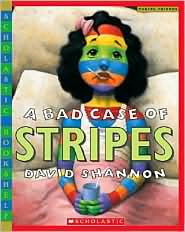
Module 6: A Bad Case of the Stripes by David Shannon

"She had no idea what to wear with those crazy stripes."
barnesandnoble.com

Citation
Shannon, D.  (1998).  A bad case of the stripes.  New York:  Scholastic Inc.

Summary
Camilla Cream is very concerned with what other people think of her.  She loves lima beans, but no one else does, so she pretends to hate them.  When her skin suddenly becomes rainbow-striped on the first day of school, she doesn't know what to do.  Her doctor cannot figure out what's wrong with her, so he sends her to school, where her skin changes colors and patterns as her classmates laugh and shout out different ideas.   The Specialists and Experts don't know what to do and the TV news has even become interested.  Finally, a little old shows up at the Cream household with a new rememdy:  a handful of lima beans.  Could the lima beans be the key to bringing back the real Camilla Cream? 

My Impressions
Richly colorful paintings and creative text make A Bad Case of the Stripes an excellent book to teach children the importance of being themselves.  Shannon's imaginative illustrations show the humor of Camilla's affliction, as her skin goes from bright stripes to a myriad of patterns to sprouting plants and fuzzy viruses until she "becomes one with the room," featuring windows for eyes and a bed for lips.  Children will giggle as they see how Camilla changes and her family tries everything to figure out what's going on. 

Reviews

Camilla Cream wants to fit in, so she conforms, denying herself the things she craves--lima beans, for example--if the other kids frown upon them. She wakes up one morning covered head to toe with party-colored stripes--not the state of affairs aspired to by a conventionalist, but it's only the beginning of her troubles. Her schoolmates call out designs and Camilla's skin reacts: polka dots, the American flag--"poor Camilla was changing faster than you could change channels on a T.V." Specialists are called in, as are experts, healers, herbalists, and gums. An environmental therapist suggests she "breathe deeply, and become one with your room." Camilla melts into the wall. It takes a little old lady with a handful of lima beans to set Camilla to rights. Shannon's story is a good poke in the eye of conformity--imaginative, vibrant, and at times good and spooky--and his emphatic, vivid artwork keeps perfect pace with the tale.

[Review of the book A bad case of the stripes by D. Shannon].  (1997, December 15).  Kirkus Reviews. Retrieved from http://www.kirkusreviews.com.

Camilla, who loves lima beans but won't eat them because it's not cool, finds that deferring to others isn't all it's cracked up to be. In fact, her desire to please and be popular causes her some spectacular problems: she suddenly breaks out in stripes, then stars, then turns "purple polka-dotty" at the behest of a delighted classmate. Her weird mutations, which stymie doctors and send the media into a frenzy, become more and more extreme until she finally blends into the walls of her room--her lips the red-blanketed mattress on her bed, her eyes the paintings on the wall. Will she never be herself again? Shannon's over-the-top art is sensational, an ingenious combination of the concrete and the fantastic that delivers more than enough punch to make up for the somewhat heavy hand behind the story, and as usual, his wonderfully stereotypic characters are unforgettable. The pictures are probably enough to attract young browsers (Camilla in brilliant stripped glory graces the jacket), and the book's irony and wealth of detail may even interest readers in higher grades.

Zvirin, S. (1998, January 1).  [Review of the book A bad case of the stripes by D. Shannon].   Booklist, 94(9).  Retrieved from EBSCOhost.


Suggested Library Uses
  • Read as part of a family storytime.  Best if the children are at least 5 years old.  Have each family member paint or draw a self-portrait expressing what is unique or special about him- or herself.  Family members can help each other come up with qualities or traits.  
  • Include in a display about differences, being yourself, or self-confidence.

Notes
Buckaroo Book Award, 2001, 2nd Runner Up (Grades K-3, Wyoming)


Find it @ your library - Albany County Library
E PB S

Sunday, October 23, 2011

Module 6: Hooway for Wodney Wat by Helen Lester

"Poor Wodney.
Wodney Wat.
His real name was Rodney Rat, but he couldn't pronounce his r's."
openlibrary.org

Citation
Lester, H.  (1999).  Hooway for Wodney Wat.  New York:  Houghton Mifflin Company.

Summary
Wodney Wat can't pronouce his r's, something for which his "wodent" classmates tease him mercilessly.  Wodney Wat hates speaking up in class.  Camilla Capybara, the new, show-off, mean student in class, makes everyone afraid of her.  And so, when Wodney Wat is chosen to lead the class in a game of Simon Says, he is terrified of what Camilla Capybara will say when she hears him speak.  Wodney's unique way of talking is misunderstood by the class bully, causing for some hilarious "Wodney says" moments that put Camilla Capybara in her place.

My Impressions
Hooway for Wodney Wat is an adorable story about how a speech impediment doesn't have to be embarassing.  The colorful language used to tell the story really brings it to life, as characters gnaw, their fur prickles, and they squeal with laughter.  The illustrations, by Lynn Munsinger cleverly show the events in the story and fill Wodney Wat with personality.  It is wonderful to see an entertaining story about being different that isn't contrived or requires the character to change to be accepted by his peers.  Wodney Wat is a loveable little wodent that will delight all children, regardless of how the speak.

Review
This author-artist team's latest foray into celebrations of differences (Tacky the Penguin, etc,) brings us Rodney Rat, a small rodent who can't pronounce his rs. His classmates' taunting has turned "Wodney" into the shyest, most miserable kid in school. "His squeak could barely be heard in class. He gnawed his lunch alone. And while the other rodents scurried and scooted about at recess, Wodney hid inside his jacket." Along comes salvation in the unlikely form of a new rodent, the mean and disruptive bully Camilla Capybara. Because she doesn't know about Wodney's speech impediment, she takes his orders in "Simon Says" literally, weeding instead of reading, waking leaves instead of raking them, and, crucially, going west instead of taking a rest. Having vanquished Camilla, Wodney is now a hero. Wodney's transformation is beautifully underscored in Munsinger's humorous, expressive illustrations: he gradually changes from hunched-over and cowering to tall and empowered, shouting instructions "in a voice so strong he had to hold his own ears." It's particularly nice that Wodney doesn't have to overcome his speech impediment to be liked; in fact, it's the impediment itself and Wodney's clever use of it that foils the villain and earns his classmates' admiration.


Parravano, M. V. (1999). [Review of the book Hooway for Wodney Wat by H. Lester]. Horn Book Magazine, 75(4), 457. Retrieved from http://www.hbook.com.


School Library Journal
PreS-Gr 2-- Poor Rodney Rat is teased mercilessly by all the other rodents because he can't pronounce his R's in this beginning to read title by Helen Lester (Houghton, 1999). When Camilla Capybara joins the class and announces that she is bigger, meaner, and smarter than any of the other rodents, everyone is afraid, especially Wodney. One day he unwittingly catches Camilla out in a game of Simon Says, and surprises himself and saves his classmates from big bully Camilla. This retelling nicely reflects Wodney's transformation from shy rodent with a speech impediment to hero of the class.

Mandell, P., & Yusko, S. (2004). [Review of the book Hooway for Wodney Wat by H. Lester]. School Library Journal, 50(2), 74. Retrieved from http://www.schoollibraryjournal.com.

Suggested Library Uses
  •  Read in a storytime and play Simon Says with the children, changing w's for r's, as Wodney does, for a fun listening and direction following activity.  Talk about speech impediments and encourage children to be kind to others who speak differently.
  • Include the book in a display about diversity.
Notes
Buckaroo Book Award, 2000, Winner (Grades K-3, Wyoming)


Wodney Wat and Camilla Capybara meet again in Wodney Wat's Wobot (Lester, 2011, Houghton Mifflin Books for Children)!

Find it @ your library - Albany County Libray
E L5673h


Sunday, October 2, 2011

Module 5: Jazz by Walter Dean Myers


"There's a steady beat walking,
and the melody's talking, too
If you ain't moving,
there must be something wrong with you"

www.goodreads.com


Citation
Myers, W.D.  (2006).  Jazz.  New York:  Holiday House, Inc.  

Summary
This picture book is a collection of fifteen lively poems and vibrant, expressive paintings to tell the story of jazz in America.  The book begins with a two-page introduction to the history and essence of jazz by the poet.  There is also a glossary and timeline at the back of the book to place the poems in their proper context.  The poems highlight the roots of jazz music, as well as its influence on American music.  The most popular instruments are given personalities and moods, including the piano, slide trombone, drums, horn, clarinet, and bass.   Select words are strategically emphasized in a colorful, dancing script, while the majority of each poem follows free verse in a old-fashioned, yet clean, typewriter font on bright backgrounds.

My Impressions    
This book practically hums with the "thum, thum, thumming" of the bass in a jazz song.  It begs to be read aloud, as each poem has its own rhythm, pulse, and cadence.  The poems truly capture the feel and mood of jazz, everything from loud and proud, to low and mournful.  Each painting brings the poem to life, with colors suited to the mood of the song, and curving, flowing portraits of jazz musicians, singers, and dancers.  The book makes for a valuable educational tool, as well, as the introduction, timeline, and glossary provide background for the poems.  Jazz is a work of art in words and images, both of which combine to create a book that exemplifies a culture that is generally very difficult to capture on paper.  

Review    
Kirkus Reviews
It takes a poet to reveal the complexities of jazz within the confines of a picture book, and with JazzWalter Dean Myers certainly fits the bill. "Jazz, for me, is people finding ways of sharing their passions and their stories through rhythm, melody and improvisation," he says. The author improvises with great dexterity here, deploying the syncopated rhythms and expressive freedom of early jazz, unfurling the brilliant harmonic complexities of bebop and releasing the intuitive shifts of swing. Myers gives each historical jazz moment due time, and his son, Christopher Myers, gives them exquisite artistic interpretation. "When painting the images for Jazz, I was thinking primarily of the community of artists that this music has brought together," says Christopher. "I sought to portray the way in which the nuanced and powerful language of jazz creates a community in much the same way a book does.Myers the father provides that language, while Myers the son links the various jazz styles with his emphatic, color-blasted brushwork. "Jazz has redefined the artistic landscape of not only music, but also literature, dance and the visual arts," says Christopher.


Jazz.  (2006).  Review of the book Jazz by W.D. Myers.  Kirkus Reviews, 74(15), 15.  Retrieved from http://www.kirkusreviews.com/

Suggested Library Uses

  • Host a jazz night for families.  Play jazz music (or invite a local jazz group), read Jazz to the audience, invite dancers to demonstrate or teach.  The timeline in the back of the book, in addition to the glossary, can be enlarged for patrons to peruse.  Other books, such as biographies of famous musicians, can also be read or highlighted.
Find it @ Your Library - Albany County LibraryE M9922J


Notes
Illustrator, Honor Book, Coretta Scott King Book Award, 2007
Notable Children's Book, 2007